Table of Contents
- Is Premium Graphic Apparel Worth It? The Honest Verdict
- Premium vs. Regular T-Shirts: What the Price Difference Actually Buys
- How to Tell If a T-Shirt Is Good Quality Before You Buy
- The Best Fabric for Graphic T-Shirts: GSM, Cotton, and Blends
- Print Quality and Printing Methods: Screen Printing vs. DTG
- Wash Durability: How Premium Tees Hold Up After 50 Washes
- The T-Shirt Barn Review: Original Designs, Inclusive Sizing, Real Value
- Verdict: Who Should Buy Premium Graphic Apparel (and Who Shouldn’t)
- Frequently Asked Questions
Last Updated: October 5, 2026
Is Premium Graphic Apparel Worth It? The Honest Verdict
Yes, premium graphic apparel is worth it if you plan to wear the shirt more than a dozen times. At The T-Shirt Barn, we sell graphic tees for a living, so we have a bias.
Premium graphic apparel is a T-shirt sold at a higher price because of better fabric, sturdier construction, and a more durable printing method, not because of the logo on the neck label.
Here is what most buying guides get wrong: they treat “premium” as a single quality tier. It is not.
Below, we break down where the extra money actually goes, how to spot quality before you buy, and how to calculate cost per wear so the decision is yours, not ours.
Premium vs. Regular T-Shirts: What the Price Difference Actually Buys
The price gap between a premium tee and a budget tee pays for four things: heavier fabric, tighter construction, better printing, and smaller production runs. As Neat Apparel’s breakdown of brand pricing versus garment value notes, a higher price tag can reflect marketing and retail overhead as easily as quality. That is the trap. Your job is to figure out which of those four things you are actually paying for.
The Cost-per-Wear Math
Cost per wear is the purchase price divided by the number of times you realistically wear the shirt. A cheap tee you wear eight times before it fades and gets demoted to a sleep shirt costs more per wear than a better tee you wear eighty times. That is the entire argument in one sentence.
Run the numbers on your own habits:
- A budget tee worn 8 times before it looks tired
- A better tee worn 80 times before the print shows real wear
- Ten times the wears means the “expensive” shirt can cost less per outing
We are not quoting you specific prices here because pricing moves and depends on the design, the size run, and current stock. Check our shop for current pricing on any design. The math works at any price point: divide, compare, and decide.
Where Budget Tees Cut Corners
Budget tees save money in predictable places. Thinner fabric. Shorter staple cotton that pills faster. A single row of stitching at the hem. A narrow neck rib that stretches out after a few washes. Cheaper ink or a heat-transfer print that cracks along the fold lines.
None of those shortcuts are visible in a product photo. They show up in month three.
The most common mistake we see is judging a tee by its first impression in the mirror. A thin shirt can feel fine on day one. It is the neckline and the print that fail first, usually within ten to fifteen washes.
How to Tell If a T-Shirt Is Good Quality Before You Buy
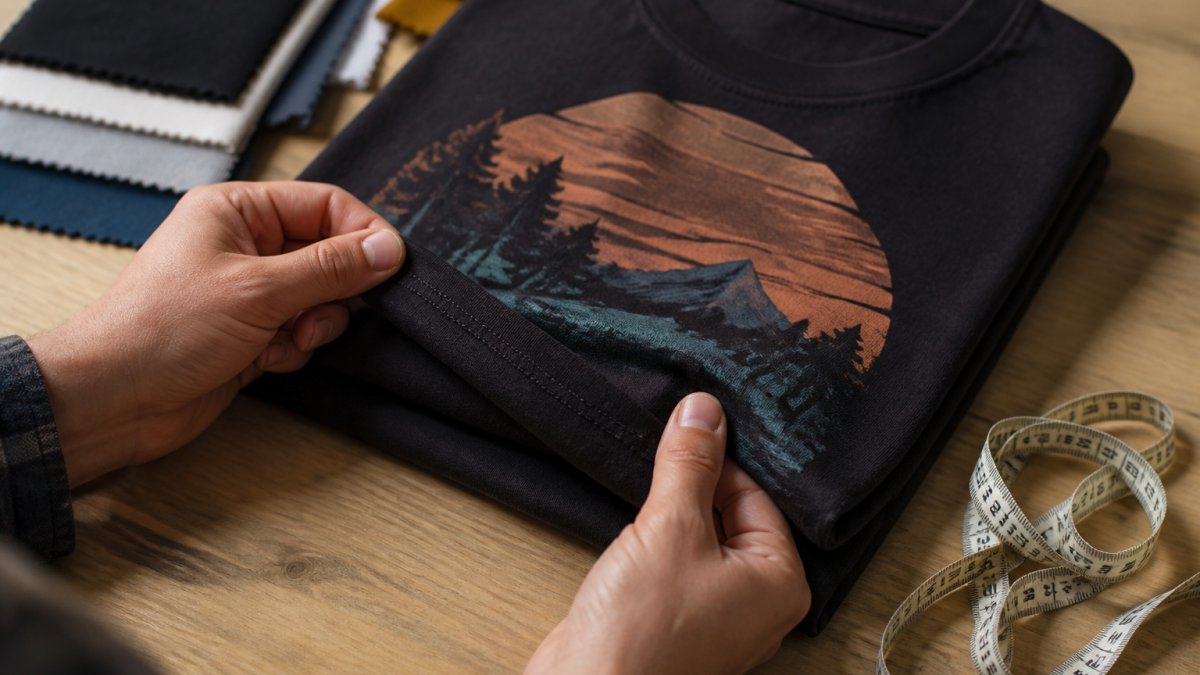
You can judge a T-shirt’s quality in about thirty seconds by checking four things: fabric weight, stitching, the neckline rib, and print feel. This works in person and, with a little practice, from product photos and spec sheets.
Fabric Weight, Stitching, and the Bacon Neck Test
Start with weight. Heavier cotton feels denser and drapes instead of clinging. Light fabric goes sheer under bright light, which is why cheap white tees are the worst offenders.
Then the stitching. Look at the hem and the sleeve seams. A double-stitched hem holds its shape. A single line of thread is a cost cut you will feel within a season.
Then the neckline. Grab the collar and stretch it gently, then let go. If it springs back flat, the rib is good. If it ripples and stays wavy, you are looking at a bacon neck in training.
Finally, the print. Press your palm on the design. A good print sits on the fabric surface without a thick plastic film. If it feels like a sticker, expect it to peel at the edges.
Check the inside of the shirt, not just the outside. A clean interior print or a soft-hand finish tells you the printer cared about how the shirt feels against skin, not just how it photographs.
The Best Fabric for Graphic T-Shirts: GSM, Cotton, and Blends
The best fabric for graphic T-shirts is 100% cotton in the 180 to 220 GSM range, or a cotton-poly blend if you want less shrinkage and faster drying. GSM stands for grams per square meter, and it is the clearest number for comparing fabric weight across brands.
Here is how the ranges shake out:
| Fabric | Typical GSM | Feel | Best For | Trade-off |
|---|---|---|---|---|
| Lightweight cotton | 140-160 | Thin, cool | Summer basics | Sheer, less durable |
| Midweight cotton | 180-220 | Substantial, soft | Graphic tees | Slightly warmer |
| Heavyweight cotton | 230+ | Dense, structured | Streetwear looks | Slower to dry |
| Cotton-poly blend | Varies | Smooth, stretchy | Everyday wear | Less natural hand feel |
Ring-spun cotton feels softer than standard cotton because the fibers are twisted tighter, which also reduces pilling. Combed cotton removes short fibers before spinning, which is why it feels smoother against skin. If a listing mentions both, that is a good sign.
Blends are not a downgrade. A cotton-poly mix resists shrinkage and wrinkles, which matters if you hate ironing. The trade-off is a slightly less natural feel. For a graphic tee you will wash constantly, that is often a fair trade.
Print Quality and Printing Methods: Screen Printing vs. DTG
Screen printing and direct-to-garment printing are the two main methods for graphic tees, and they fail in different ways. Screen printing pushes thicker ink through a mesh screen.
Screen printing wins on color vibrancy and longevity. The ink sits on top of the fabric and holds up through heavy washing. It is also the better choice for bold, high-contrast designs.
DTG wins on detail and flexibility. It handles gradients, fine lines, and photographic artwork that screen printing struggles with. It also makes small runs practical, which is why it suits original designs produced in limited quantities rather than mass-market graphics.
What matters most for durability is not the method itself but the pairing. A great print on a weak garment still fails, because the shirt stretches and distorts underneath the ink.
Print method determines how a design looks and how long it lasts. Garment quality determines whether the shirt is still worth wearing when the print is fine. You need both.
Wash Durability: How Premium Tees Hold Up After 50 Washes
Wash durability is where premium tees earn their price. The failure points are predictable: fading, cracking, peeling, and shrinkage. Each one traces back to a specific shortcut in fabric or printing.
Fading happens when dye quality is low or the print ink is thin. Cracking happens when a heavy print film cannot flex with the fabric, so it splits along fold lines.
Premium tees address all four. Better dye retention, ink that bonds with the fiber instead of sitting on top of it, and pre-shrunk fabric that holds its size.
You can test this yourself without a lab. Wash a new tee inside out in cold water and air dry it.
Care instructions matter here, and they are not just legal boilerplate. Cold water, inside out, low heat or air dry.
The T-Shirt Barn Review: Original Designs, Inclusive Sizing, Real Value
The T-Shirt Barn sells graphic tees built around original designs, including apparel from Axtacy Apparel, Good English Clothing, and Kush Dynasty League. The catalog spans bold statements, pride-inspired graphics, and humorous tees, with sizing meant to work across body types and identities.
What we do well:
- Original artwork. The designs are made for us, not scraped from a marketplace. That matters if you are tired of seeing the same graphic on five different storefronts.
- Inclusive sizing and messaging. Pride-focused and identity-driven designs sit alongside subtle graphics, so you are not forced into one aesthetic.
- Brand variety. Carrying several labels under one roof means you can find a fit and a style that suits you without hopping between sites.
Where we are honest about limits: we are a small operation, and our catalog is curated rather than endless. If you want to browse tens of thousands of user-uploaded designs, a marketplace will out-volume us every time. We would rather carry fewer designs we can stand behind.
On pricing, we are not going to quote numbers in an article that will be stale next month. Check the product pages for current pricing, and run the cost-per-wear math above before you decide.
Shoppers who want original, expressive graphic tees with inclusive sizing and designs that are not mass-produced, rather than the biggest possible catalog.
Verdict: Who Should Buy Premium Graphic Apparel (and Who Shouldn’t)
Buy premium graphic apparel if you wear your tees often, care about fit and print longevity, and want designs that feel personal.
The decision comes down to three questions:
- How often will you wear it? Frequent wear favors better construction.
- Does the design matter to you? Original art on a durable shirt is the whole point.
- Do you mind laundry care? Premium tees reward cold washes and air drying.
If you answered yes to the first two and do not mind the third, the math works in your favor. If you want a rotating pile of cheap tees for the gym, budget options are fine and we will not pretend otherwise.
The real difference between a premium tee and a budget tee is not the label. It is what the shirt looks like on wash fifty. That is the whole test, and it is the one we build our catalog around.
Choosing graphic tees that actually last comes down to fabric, construction, and print quality working together, and that is exactly where we focus.
Frequently Asked Questions
What makes a graphic T-shirt premium quality?
Premium graphic tees typically use heavier cotton (often 180-220 GSM), tighter stitching at the neckline and hems, and printing methods that bond ink into the fabric rather than sitting on top. Construction details matter too: side seams that prevent twisting, reinforced shoulder taping, and pre-shrunk fabric. The result is a shirt that keeps its shape, color, and print through repeated washing. Premium graphic apparel costs more upfront because those materials and production steps cost more to source and execute.
Do premium graphic tees last longer than budget tees?
In most cases, yes. Budget tees often use lighter fabric and cheaper inks that fade or crack after 10-15 washes. Premium tees with quality screen printing or direct-to-garment printing and heavier cotton can hold up for 50 washes or more without visible print degradation. The exact lifespan depends on the printing method, ink type, and how you care for the shirt. Washing inside out in cold water and air drying extends the life of any graphic tee.
How can I tell if a graphic T-shirt is well made before ordering online?
Look for specific details in the product description: fabric weight (GSM), cotton type, stitching description, and printing method. Check customer reviews for mentions of shrinkage, fading, or fit issues. A brand that publishes its fabric specs and print method is usually more confident in its product. Also look for size charts with actual measurements, not just S/M/L labels. If a listing has no construction details and no reviews mentioning durability, treat it as a gamble.
Is premium graphic apparel worth the extra cost compared to fast fashion?
It depends on how often you wear the shirt. A budget tee that fades after 15 washes costs less per shirt but more per wear if you replace it three times a year. Premium graphic apparel from brands that use quality fabric and durable printing often works out cheaper on a cost-per-wear basis, especially for designs you wear weekly. If you buy graphic tees for one-time events or trend pieces, budget options make sense. For everyday staples, premium usually wins.
Are graphic tees still in style in 2026?
Yes. Graphic tees remain a core part of casual and streetwear fashion in 2026. The shift is toward original artwork and niche designs rather than mass-produced slogans. Consumers increasingly look for designs that reflect personal identity, whether that is humor, pride, music, or art. Brands that offer exclusive, original graphics and inclusive sizing are seeing steady demand. The key trend is authenticity: buyers want to know the design is original and the garment is built to last.