Table of Contents
- The 30-Second Quality Check: What to Look For First
- Fabric Weight and GSM: The Foundation of High Quality Graphic Tees
- Heavyweight Cotton T-Shirt Benefits: Breathability, Opacity, and Longevity
- Screen Printing vs Direct to Garment Quality: Which Print Lasts Longer?
- Stitching, Side Seams, and Construction Details That Signal Quality
- How to Wash Graphic Tees to Preserve Print and Fabric
- Sustainability and Ethical Sourcing: What Labels Don’t Tell You
- Frequently Asked Questions
Last Updated: September 28, 2026
The 30-Second Quality Check: What to Look For First
Spotting high quality graphic tees comes down to three quick tests: pinch the fabric for weight and opacity, check the side seams for twisting, and rub your thumb across the print to feel how thickly it sits on the cloth. Fail any check, put it back.
Fabric Weight and GSM: The Foundation of High Quality Graphic Tees
GSM stands for grams per square meter, and it measures how much fabric a shirt actually contains. Lightweight tees run around 140-160 GSM, midweight near 180, and heavyweight starts around 200 GSM.
Why Heavier Fabric Resists Shrinkage and Pilling
Heavier knits use denser yarn structures, so fibers have less room to migrate and tangle during washing. Pilling happens when loose fibers surface and ball up, and a denser knit gives them fewer escape routes. Shrinkage works the same way: cotton relaxes with heat and moisture, and a denser fabric has already shed much of that tension during manufacturing. Lighter fabrics can shrink noticeably on the first wash; heavier ones move far less.
Heavyweight Cotton T-Shirt Benefits: Breathability, Opacity, and Longevity
Heavyweight cotton t-shirts deliver three benefits lighter alternatives struggle to match: better opacity, slower wear, and surprisingly good breathability. A dense cotton knit wicks moisture and lets air move through the yarn structure, while a thin, tightly fused fabric traps heat against your skin.
Heavier fabric isn’t about stiffness. It’s about a denser knit that holds shape, blocks light, and gives the print a stable surface. That combination is what makes a tee last.
Screen Printing vs Direct to Garment Quality: Which Print Lasts Longer?
Screen printing generally outlasts direct to garment printing on graphic tees: screen-printed ink is pushed through a mesh stencil and cured into a thick, bonded layer, while DTG ink sits closer to the surface and fades faster with washing. The more useful skill is diagnosing which failure mode you’re looking at, because cracking and fading are different problems, and only one is visible before you buy.
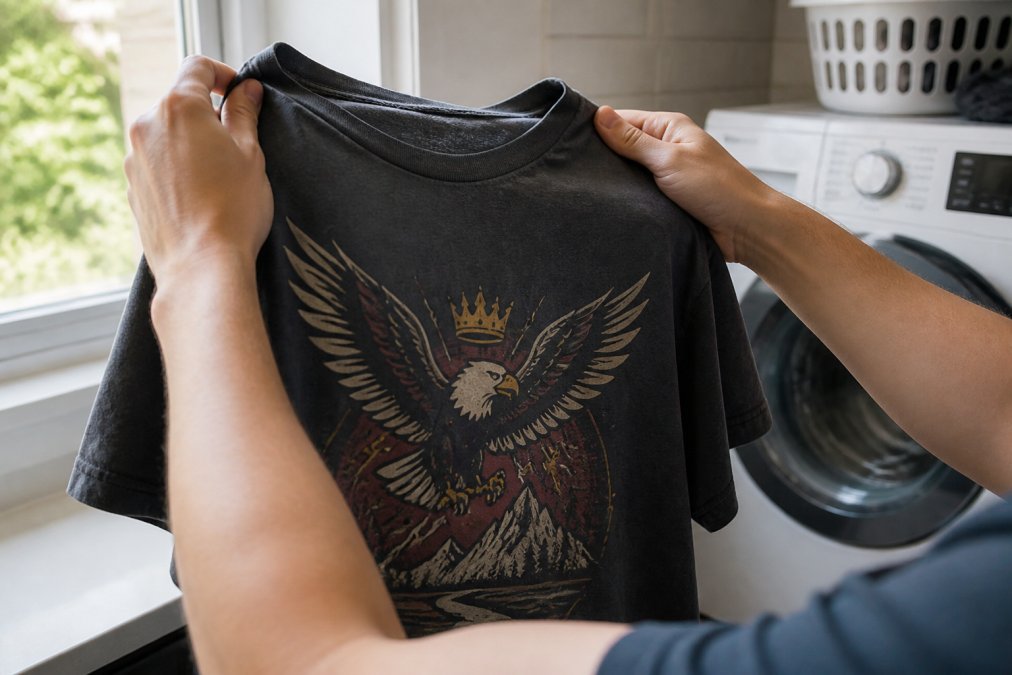
Here’s the practical breakdown:
| Print Method | Best For | Durability | Detail Level | Failure Mode |
|---|---|---|---|---|
| Screen printing | Bold graphics, solid colors, bulk orders | Holds up over many washes | Moderate to high | Cracking along stretch lines |
| Direct to garment | Photo-real art, gradients, small runs | Fades faster with heavy washing | Very high | Fading and wash-out, especially on dark fabric |
Cracking vs Fading: How to Tell Which One You’re Looking At
These words get used interchangeably, but they describe different failures. Cracking is mechanical: the cured ink layer can’t stretch as far as the knit underneath, so it splits into fine white lines along the chest, shoulders, or anywhere the shirt flexes. Fading is chemical and abrasive: the ink is intact, but the pigment has dulled or washed out, often unevenly.
How to Test Print Durability Before You Buy
Run your thumb firmly across the printed area. A well-cured print feels like part of the fabric, slight texture, no tackiness. If the ink feels like a raised plastic sheet or you can catch an edge with your fingernail, it will likely peel or crack.
Cracking and fading are not the same problem. Cracking is a stretch failure you can test for in the store by pulling the fabric under the print. Fading is a wash-and-heat failure you manage afterward with cold water and air drying.
What the Print Should Feel Like After Ten Washes
If you already own the shirt, compare it to how it felt new. A cracking print feels rougher along high-flex areas, with cracks running perpendicular to the direction you stretch. A fading print feels unchanged but looks duller where abrasion is worst, under a bag strap, across the chest, at the hem. Neither failure is reversible, which is why pre-purchase tests matter more than any care tip.
Stitching, Side Seams, and Construction Details That Signal Quality
Construction is where budget tees give themselves away fastest. Check side seams first: on a well-made shirt they run straight and vertical from armpit to hem; on a cheap one they twist toward the front after a wash or two, pulling the shirt off-center. Then check stitch density at hems and shoulders, denser, even stitching holds up better. Look for taped shoulder seams, where a strip of fabric covers the seam so it doesn’t rub, and a ribbed collar with real elasticity rather than a flat band that stretches out.
- Side seams that run straight and stay straight
- Even, dense stitching at hems and sleeves
- Taped shoulder seams for comfort and structure
- Ribbed collar that snaps back when stretched
- No loose threads or skipped stitches at stress points
The twist test matters more than most shoppers think. Grab a shirt by the shoulders and let it hang. If the side seam curves toward the front before you’ve even washed it, expect it to get worse. Twisted seams can’t be fixed, and the shirt will never hang straight.
How to Wash Graphic Tees to Preserve Print and Fabric
Washing graphic tees correctly is simpler than most care labels suggest: turn the shirt inside out, wash cold, and skip the dryer. Heat is the enemy of both print and cotton, and most print damage happens in the dryer, not the wash. Follow this routine:
- Turn the shirt inside out before it goes in the machine
- Wash on cold with like colors, on a gentle cycle
- Skip fabric softener, which leaves residue that dulls prints
- Hang dry or lay flat, away from direct sun
- If you must use a dryer, choose low heat and pull the shirt out slightly damp
Sustainability and Ethical Sourcing: What Labels Don’t Tell You
Sustainability claims on graphic tees range from meaningful to decorative, and the label alone rarely tells you which is which. Look for specifics rather than slogans: a brand that names its mill, fiber source, or a recognized certification gives you something to verify, while “eco-friendly” with no detail gives you a feeling. Ethical sourcing and material quality travel together, a brand that can trace its cotton to a specific mill usually also knows its fabric weight, knit density, and print chemistry.
The Certifications Worth Knowing
A handful of third-party certifications do real work because they require audits rather than self-reporting. You don’t need to memorize them all, just recognize the ones on hangtags and product pages.
- GOTS (Global Organic Textile Standard) covers the whole chain from fiber to finished garment, including social and environmental criteria at each stage. It’s the strongest single signal for organic cotton apparel.
- OEKO-TEX Standard 100 tests the finished fabric for harmful substances, things like residual pesticides, heavy metals, and formaldehyde. It says nothing about organic farming or labor, but it’s a meaningful safety check on what touches your skin.
- Fair Trade Certified focuses on labor conditions and worker premiums at the sewing stage. It’s the certification most directly tied to the people who cut and stitch the shirt.
- bluesign applies mainly to textile chemistry and mill-level environmental impact. You’ll see it more on performance fabrics than on basic cotton tees, but it shows up on some premium blanks.
Fiber Language That Actually Means Something
Organic cotton means the fiber was grown without synthetic pesticides under a certified standard. Combed cotton means short fibers were removed before spinning, producing a smoother, stronger yarn. Neither term is regulated as marketing language, so the certification behind the claim is what counts: “made with organic cotton” can describe a blend, while “GOTS certified organic cotton” must meet a chain-of-custody standard.
Supply-Chain Questions That Get Real Answers
For shoppers who care where their clothes come from, the most useful habit is asking direct questions. A few separate the brands doing the work from the ones borrowing the vocabulary:
- Where is the cotton grown, and where is the shirt cut and sewn? A brand that knows its mill can usually answer both. A brand that only knows its printer often can’t.
- Which certifications apply to the finished garment, not just the fiber? GOTS covers the whole chain; a fiber-only organic claim does not.
- What happens to unsold or returned inventory? Brands that donate, recycle, or hold stock answer this plainly. Brands that don’t know often deflect.
- Is the print chemistry disclosed? Water-based and discharge inks are common on higher-end graphic tees and are generally considered lower-impact than heavy plastisol. A brand that can name its ink type is usually a brand that knows its printer.
If a brand lists a certification, check the certification body’s own database rather than the brand’s website. GOTS and OEKO-TEX both maintain searchable registries, and a quick lookup tells you whether the claim is current and applies to the specific product you’re holding.
Why This Belongs in a Quality Guide
It’s tempting to treat sustainability as separate from fabric weight and stitch density. In practice they’re the same conversation. A shirt made from traced, certified cotton by an audited factory is one whose maker had to document its inputs, and documented inputs are how you get consistent GSM, dye lots, and print curing. The label isn’t a guarantee of quality, but the absence of any verifiable claim is a useful signal.
Frequently Asked Questions
How can I tell if a graphic tee is high quality before buying online?
Look for specific details in the product listing: fabric weight in GSM (180+ for standard, 220+ for heavyweight), whether it uses ring-spun or combed cotton, the print method (screen printing vs DTG), and construction details like taped shoulder seams and a ribbed collar. Brands that share this information openly are usually confident in their product. If the listing only shows a mockup and vague claims like ‘premium quality’ without specifics, that’s a red flag.
Does fabric weight determine the quality of a graphic tee?
Fabric weight is a strong indicator but not the only one. A 220 GSM heavyweight cotton t-shirt will feel more substantial, drape better, and resist shrinkage compared to a 150 GSM shirt. However, a heavyweight shirt with poor stitching or a cheap print will still fall apart. Quality comes from the combination of fabric weight, fiber length, weave density, and construction. Use GSM as your starting filter, then check print method and stitching.
What are the signs of a durable screen print?
A durable screen print has crisp edges with no blurring, sits slightly on top of the fabric rather than soaking in, and passes the stretch test: gently pull the fabric around the print. If the ink cracks or separates from the fabric, it won’t survive many washes. Screen printing with plastisol ink typically outlasts DTG prints because the ink bonds more deeply with the cotton fibers. Also check that the print has been properly cured, which you can often tell by the feel.
How do I prevent graphic tee prints from cracking?
Wash graphic tees inside out in cold water on a gentle cycle. Skip the dryer or use low heat, because high heat breaks down the ink and causes cracking. Never iron directly over the print. Use a mild detergent without bleach or fabric softener, which can degrade the print over time. Following these steps can significantly extend the life of both screen-printed and DTG designs.