Table of Contents
- How a T-Shirt Should Fit: The Four Checkpoints of a Perfect Fit
- What You’ll Need: A Soft Tape Measure and Two Minutes
- How to Measure for a T-Shirt: Chest, Shoulders, and Length
- Using a Graphic Tee Size Guide Without Getting Burned
- How to Choose a T-Shirt Size Online: Reading Charts and Reviews
- Troubleshooting Fit by Body Area: Too Tight, Too Loose, and Everything Between
- Conclusion: Measure Once, Wear Confidently
- Frequently Asked Questions
Last Updated: October 12, 2026
How a T-Shirt Should Fit: The Four Checkpoints of a Perfect Fit
A perfect fit sits clean on your shoulders, skims your chest without pulling, ends at a length you chose on purpose, and lets you move without thinking about it.
This guide from The T-Shirt Barn walks through four checkpoints: shoulders, chest, length, and movement. Get those right and every graphic tee you buy online stops being a coin flip.
Most size guides treat “small, medium, large” as if bodies come in three shapes.
So measure instead of guessing. Two minutes with a soft tape measure beats a drawer full of returns.
Fit is four checkpoints, not one number. Shoulders, chest, length, and movement. Miss any of them and the shirt feels off, even if the tag says your usual size.
What You’ll Need: A Soft Tape Measure and Two Minutes
Grab a soft tape measure, the kind that bends, a stiff metal tape won’t wrap around your body and gives wrong numbers. No tape? A piece of string and a ruler work fine.
Total time: about two minutes.
Difficulty: easy.
You’ll also want:
- A fitted t-shirt you already like the fit of
- A mirror, or a friend for the shoulder measurement
- A flat surface to lay the shirt on
How to Measure for a T-Shirt: Chest, Shoulders, and Length
Stand up straight and breathe normally. You want the numbers your body actually is, not the ones you wish it were.
Here’s how to measure for a t-shirt, in order:
- Chest: Wrap the tape around the fullest part of your chest, under your arms. Keep it level all the way around. Snug, not tight.
- Shoulders: Measure across your back from the edge of one shoulder to the edge of the other. This is the one measurement worth asking a friend for.
- Length: Measure from the top of your shoulder, near the neck, straight down to where you want the hem to land.
Write all three down, plus waist and hips if you’re between sizes or buying a longer cut.
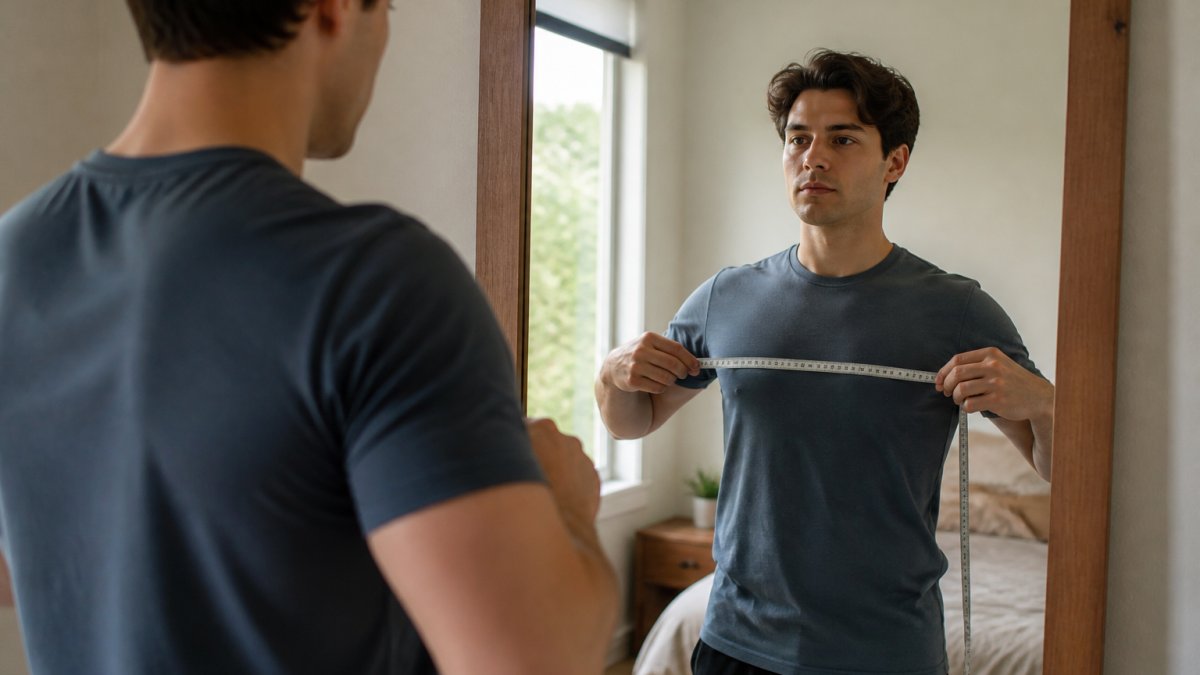
Getting Accurate Measurements on Bare Skin
Measure over bare skin or a thin fitted shirt, never over a hoodie. Thick fabric adds inches that aren’t you. Keep the tape parallel to the floor, and check it in a mirror so it doesn’t twist at the back.
Using a Graphic Tee Size Guide Without Getting Burned
A graphic tee size guide lists the flat measurements of the actual shirt, not your body. Body measurements tell you what you are; garment measurements tell you what the shirt is. Most shoppers conflate the two and end up returning perfectly good shirts.
So lay your favorite tee flat and measure it the same way:
- Armpit to armpit, then double it for chest width
- Shoulder seam to shoulder seam
- Collar to hem for length
Compare those numbers to the chart. If a medium measures 20 inches across the chest and your best-fitting shirt measures 19, the medium runs a touch roomy.
| Checkpoint | What to Measure | Why It Matters |
|---|---|---|
| Shoulders | Seam to seam across the back | Wrong width makes the sleeves droop or pull |
| Chest | Armpit to armpit, doubled | Controls tightness and how the print sits |
| Length | Collar to hem | Decides tucked, untucked, or cropped look |
| Movement | Reach, sit, and stretch test | Shows if the fabric has enough ease |
Brands cut shirts differently even at the same labeled size, so always check the specific chart on the product page. A “large” from one maker can fit like a medium from another.
The Universal Definition of a Perfect Fit
Before any chart, you need a definition that works across every garment. A perfect fit is clothing that:
- Sits where it was designed to sit. Shoulder seams land on your shoulder bone. Waistbands rest at your natural waist or hip, depending on the rise. Hems stop where the cut intends.
- Skims without strain. Fabric follows your shape without pulling, gaping, or bunching. You can slide a finger under the waistband of trousers. You can raise your arms in a jacket without the collar choking you.
- Moves with you. You can sit, reach, bend, and climb stairs without the garment riding up, twisting, or restricting your breath.
- Feels intentional. Loose is a choice, not an accident. Tight is a style, not a squeeze. The silhouette matches the look you set out to achieve.
That definition is the same whether you’re buying a $12 graphic tee or a $400 blazer. The measurements change. The standard doesn’t.
Applying the Definition Across Garment Categories
Here’s how the same four-part definition translates across the garments you actually buy:
Tops and tees: Shoulder seam on the shoulder bone. Chest fabric lies flat without horizontal pull lines. Hem hits mid-fly for a classic look, or higher for a cropped cut.
Trousers and jeans: Waistband stays put when you sit. No horizontal wrinkles radiating from the crotch (a sign of tightness).
Dresses: Bust darts point at your bust apex, not above or below it. Waist seam sits at your natural waist.
Jackets and blazers: Shoulder seam ends at the edge of your shoulder bone.
Bras: Band stays level around your ribcage and doesn’t ride up when you raise your arms.
How Fabric, Stretch, and Ease Change the Math
Two shirts with identical measurements can fit completely differently. Fabric and ease explain why.
- Stretch percentage: A cotton-spandex blend with 5% spandex forgives a half-inch of tightness. A 100% cotton poplin does not. Check the fabric content before you trust a chart.
- Intended ease: Ease is the extra room a designer builds in beyond your body measurements. A slim-fit tee might have 1 inch of ease at the chest. A relaxed-fit tee might have 4. Same body, different chart targets.
- Weave and weight: A stiff oxford cloth holds its shape and shows every pull line. A fluid jersey drapes and hides small fit issues. Heavier fabrics also shrink less predictably than lightweight knits.
People who rarely return clothing buy for the fabric, not just the number: stiff fabric with no stretch means size up, a forgiving knit means buy true to size.
At The T-Shirt Barn, we list flat measurements for our graphic tees so you can match them against a shirt you already own.
How to Choose a T-Shirt Size Online: Reading Charts and Reviews
Buy the size that matches your largest checkpoint, then adjust for the look you want. If your chest says medium but your shoulders say large, go large and let the body drape.
At The T-Shirt Barn, we list flat measurements for our graphic tees so you can match them against a shirt you already own. It’s a small thing that removes most of the guesswork.
Troubleshooting Fit by Body Area: Too Tight, Too Loose, and Everything Between
Fit problems show up in predictable places. Read what each symptom means, then decide whether the fix is a different size, cut, or a trip to the tailor.
Reading the Symptoms
Drooping or slipping shoulders. The shoulder seam sits past your natural shoulder line, so sleeve fabric hangs off your arm.
Riding up at the waist. The length is too short for your torso, or the rise is wrong.
Baggy through the body but tight at the shoulders. The garment is cut for a different proportion than yours.
Restricted movement. You can’t raise your arms, sit comfortably, or take a full breath.
The At-Home Movement Test
Before keeping or returning any garment, run this five-step test in front of a mirror:
- Reach overhead. Both arms straight up. The hem should not rise past your navel on a top, and the waistband should not pull down on trousers.
- Sit down. Cross your legs if you can. The waistband should not dig in, and the back of the shirt should not ride up past your lower back.
- Bend forward. Touch your toes. The back of the garment should not pull tight enough to strain the seams.
- Hug yourself. Wrap both arms across your chest. The shoulders should not bind, and the back should not gap open.
- Walk ten steps and turn around. The garment should stay in place. If it twists, shifts, or needs constant adjustment, the fit is off.
Pass all five and it fits. Fail one and note which, that tells you exactly what to fix.
Don’t size down hoping a shirt will “stretch out.” Cotton shrinks in the wash more often than it relaxes, and a shirt that’s tight on day one is usually tighter after the first dry cycle. Stretch fabrics recover, they don’t expand permanently.
Size Up, Size Down, or Alter?
Once you’ve identified the problem, the decision is simple:
- Size up if the garment is tight at multiple points and the fabric has no stretch. A larger size fixes chest, shoulder, and length issues at once.
- Size down only if the garment is loose everywhere and the fabric has significant stretch. Otherwise, sizing down creates new problems at the shoulders and chest.
- Change the cut if the garment fits at one point but not another. A different silhouette, relaxed, slim, curvy, tall, petite, addresses proportion mismatches that no size will fix.
Inclusive Fit: When Standard Sizing Doesn’t Match Your Body
Standard size charts are built around average proportions that don’t describe most people. If you’re tall, petite, broad-shouldered, long-torsoed, curvy, or have mobility needs, the labeled size may never fit correctly, that’s not a failure on your part.
A few practical adjustments:
- Shop brands that publish flat measurements, not just size labels. You can compare numbers instead of guessing.
- Look for tall, petite, curvy, and adaptive lines. These adjust proportions, not just circumference.
- Prioritize shoulder and bust fit on structured garments. Those are the hardest to alter. Waist, hem, and sleeve length are easy.
- For adaptive needs, look for magnetic closures, seated-fit patterns, and side-opening designs. These are increasingly available from mainstream brands, not just specialty retailers.
A perfect fit isn’t about matching a number, it’s about the garment covering, moving, and looking the way you intended.
Conclusion: Measure Once, Wear Confidently
Getting the fit right takes two minutes and saves a pile of returns.
At The T-Shirt Barn, we make that easy with original graphic designs, inclusive sizing for every body, and exclusive apparel from brands like Axtacy Apparel, Good English Clothing, and Kush Dynasty League.
Ready to find the perfect fit in a design that’s actually yours? Shop Now and wear it with confidence.
Frequently Asked Questions
How should a graphic tee fit?
A graphic tee should fit cleanly across the shoulders and chest without pulling at the seams, with the hem landing around mid-fly or upper hip. The sleeve should end mid-bicep, and you should be able to pinch about 1-2 inches of fabric at the waist. It should feel comfortable enough to move in while sitting, reaching, and raising your arms.
How do you measure yourself for a T-shirt?
Use a soft tape measure against bare skin or a fitted shirt. Measure around the fullest part of your chest, around your natural waist, and around your hips. For length, measure from the base of your neck down to where you want the hem to sit. Write these numbers down and compare them to the brand’s size chart before ordering.
Should you size up or down in a graphic tee?
Size up if you want a relaxed or oversized streetwear look, or if the shirt is 100% cotton and may shrink slightly after washing. Size down only if the brand’s chart shows their sizing runs large. When in doubt, check customer reviews for fit notes, since sizing varies widely between graphic tee brands.
How do you know if a T-shirt is too tight or too big?
Too tight: the fabric pulls across the chest, the sleeves dig into your arms, and the hem rides up when you raise your arms. Too big: the shoulders droop past your natural shoulder line, the body billows out, and the sleeves hang past mid-bicep. A proper fit sits between these extremes, allowing comfortable movement without excess fabric.
Finding a shirt that fits is half the battle. Finding one that says something is the other half. The T-Shirt Barn carries original graphic tees with flat measurements listed on every product page, inclusive fits for all body types, and exclusive designs you won’t find on the mass-market sites. Get started with The T-Shirt Barn and find the fit and the statement that feel like you.