Table of Contents
- Cotton Bureau vs TeePublic: How the Two Platforms Compare
- Print on Demand Royalty Comparison: What Creators Actually Earn
- Print Quality, Garment Selection, and Technical Print Specs
- Design Submission, Approval, and Copyright Protection
- Best Print on Demand Sites for Artists: Where Cotton Bureau and TeePublic Fit
- Shipping, Fulfillment, and Long-Term Scalability
- Frequently Asked Questions
Last Updated: September 27, 2026
Cotton Bureau vs TeePublic: How the Two Platforms Compare
Choosing between Cotton Bureau vs TeePublic for creators comes down to one question: do you want a curated gallery or an open marketplace? According to the U.S. Copyright Office’s registration guidance, artists who understand where their work is displayed and how it’s licensed make better long-term decisions about their creative output. Cotton Bureau is a curated platform that accepts a limited number of designs and handles production in-house. TeePublic is an open marketplace where anyone can upload artwork and set their own markup. That single structural difference shapes everything else: royalties, quality control, and how much say you keep over your work.
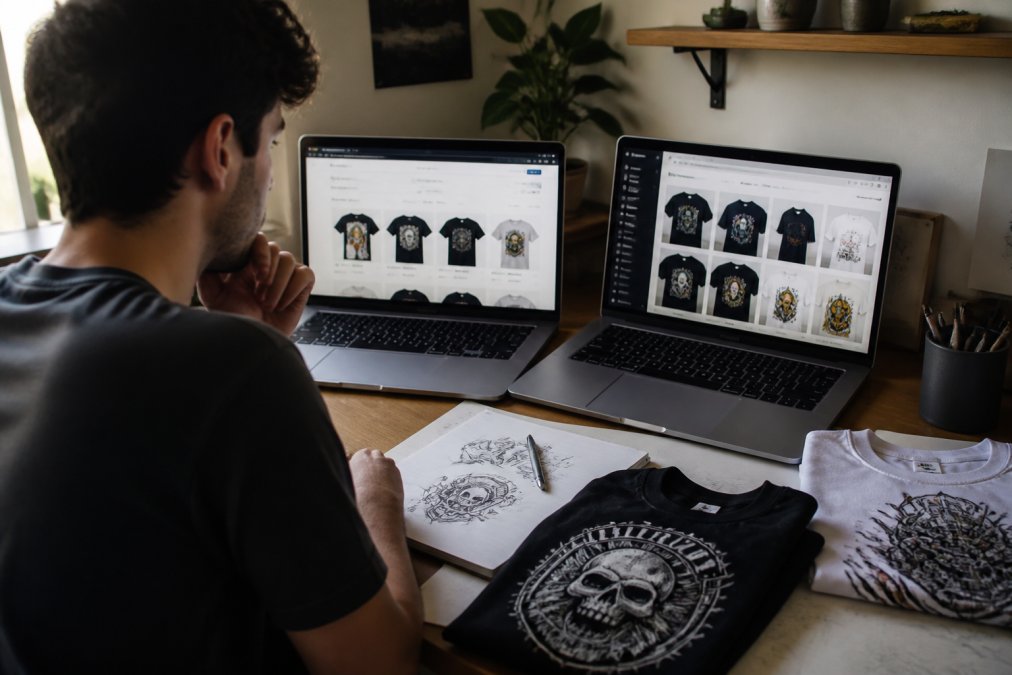
Curated Drops vs Open Marketplace
Cotton Bureau operates like a gallery. You submit a design, the team reviews it, and if it’s accepted, it runs for a limited window. TeePublic works like a flea market with no bouncer. Anyone can upload, and every design stays live indefinitely.
That difference cuts both ways. Curated drops create scarcity and a sense of occasion. Open marketplaces create volume, which means more competition but also more chances to be discovered by niche buyers.
Print on Demand Royalty Comparison: What Creators Actually Earn
A print on demand royalty comparison usually starts with the same mistake: comparing headline percentages without checking the base garment cost underneath them. Cotton Bureau pays a flat commission per accepted design sale, and the platform sets the retail price. TeePublic lets you choose a markup on top of the base cost, and you keep that markup.
Here’s the practical breakdown:
| Factor | Cotton Bureau | TeePublic |
|---|---|---|
| Pricing control | Platform sets retail price | You set your markup |
| Payout trigger | Per accepted design sale | Per item sold |
| Design approval | Required before listing | None |
| Royalty type | Flat commission | Markup-based |
| Earnings ceiling | Capped by platform’s set commission | Capped only by what buyers will pay |
| Earnings floor | Higher per sale, fewer sales | Lower per sale, more potential volume |
Base Garment Cost and Platform Fees
The base garment cost is what the platform pays for the blank shirt, and it comes out of the retail price before your cut on most marketplaces. On TeePublic, your earnings are the markup you set, not the full sale price. On Cotton Bureau, the platform handles pricing and pays you a set commission, which removes guesswork but also removes upside.
What most guides miss is that neither model rewards passive uploading. Both reward designs that match a specific audience.
How the Math Actually Works at Volume
The royalty model you pick changes your income curve, not just your per-sale number. A markup-based marketplace pays you a small amount per item, so your income scales almost linearly with units sold. A flat-commission curated platform pays more per accepted design, but the number of designs that get accepted, and the sales window each one runs, caps how fast that income can grow.
A common pattern among creators who track their numbers: a design that earns a modest markup per shirt on an open marketplace can out-earn a higher flat commission on a curated platform once it clears a few hundred units, simply because the open marketplace never stops selling it. The reverse is true for a design with a short, intense demand spike, a holiday graphic, a meme, a moment, where the curated platform’s higher per-sale payout wins because the window is short anyway.
Two other costs eat into the headline number on both platforms:
- Payment processing and platform fees. Marketplaces typically net these out before your royalty lands, so the number in your dashboard is already the post-fee figure. Curated platforms usually fold fees into their commission structure, which is why the per-sale number looks cleaner but is not directly comparable.
- Returns and chargebacks. On open marketplaces, a returned item usually reverses the royalty. On curated platforms with limited windows, returns are less common because buyers are self-selecting into a specific drop.
Before you commit to either platform, run the math on your ten best-selling designs, not your ten favorites. The designs that sell are rarely the ones you’d frame on a wall. Then model two scenarios: one where each design sells 50 units, and one where each sells 500. The platform that wins at 50 units is often not the platform that wins at 500.
Which Royalty Model Fits Which Creator
If you have a small catalog of strong, evergreen designs and you want predictable per-sale income without managing prices, the flat-commission model removes decisions. If you have a large or fast-growing catalog and you’re willing to experiment with markup pricing, the markup model gives you a lever the curated platform does not. Neither is objectively better, they reward different working styles.
Print Quality, Garment Selection, and Technical Print Specs
Print quality on both platforms depends on the printing method, and the method determines how a design holds up after repeated washes. Cotton Bureau leans on screen printing for larger runs, which lays down thicker ink and tends to survive more wash cycles. TeePublic relies primarily on direct-to-garment printing, which handles full-color photographic designs well but can fade faster on dark garments.
Garment selection matters just as much. Both platforms offer standard cotton tees, and both have expanded into heavier weights and blended fabrics.
Direct-to-Garment vs Screen Printing
Direct-to-garment printing works like an inkjet printer for fabric. It sprays ink directly onto the shirt, which makes short runs and complex color gradients affordable. Screen printing pushes ink through a mesh screen, one color at a time. It costs more to set up but produces bolder, longer-lasting results at volume.
Design Submission, Approval, and Copyright Protection
Design submission works differently on each platform, and the difference affects how much copyright protection you effectively retain. Cotton Bureau requires you to submit work for review, and accepted designs go through a formal approval process before they appear in the store. TeePublic accepts uploads automatically, with no gatekeeping.
What the Submission Process Actually Requires
On a curated platform, submission is a real gate. You typically upload your artwork, describe the concept, and wait for a human review. Acceptance is not guaranteed, and a rejection usually comes with little explanation. The upside is that accepted designs get promoted to an audience that trusts the platform’s taste, you inherit some of that credibility.
Copyright and IP Protection: The Part Most Guides Skip
This is where the two platforms diverge in a way that matters more than most creators realize.
Uploading a design to an open marketplace does not register your copyright. If someone copies your work, registration is what gives you real legal use, and you can’t register retroactively once infringement starts. Keep your original source files, your creation dates, and your upload timestamps, they are the evidence you’ll need if you ever file a takedown or a suit.
Practical IP Hygiene for Creators on Either Platform
A few habits protect you regardless of which platform you choose:
- Keep your layered source files. A flattened PNG proves you uploaded something; a layered source file proves you made it.
- Register in batches. The U.S. Copyright Office allows group registration for certain collections of works, which is far cheaper than registering each design individually.
- Watermark your public previews. It won’t stop a determined thief, but it stops casual scraping and makes takedowns easier to justify.
- Monitor both platforms. Infringers often cross-post. A design stolen on one marketplace frequently shows up on the other within weeks.
The platform you choose affects how quickly you can react to infringement, but it does not change your underlying rights. Registration and documentation are what give those rights teeth, and they are entirely within your control on either platform.
Best Print on Demand Sites for Artists: Where Cotton Bureau and TeePublic Fit
The best print on demand sites for artists depend on what you’re optimizing for. Cotton Bureau fits designers who want curation, higher production standards, and a gallery-style presentation. TeePublic fits artists who want zero barriers, volume, and full control over their own markup.
Shipping, Fulfillment, and Long-Term Scalability
Shipping logistics and fulfillment reliability decide whether customers come back. Both Cotton Bureau and TeePublic handle production and shipping on your behalf, which is the core appeal of print on demand: no inventory, no packing, no trips to the post office.
Frequently Asked Questions
Is Cotton Bureau good quality?
Cotton Bureau is known for stricter curation and higher-end garment blanks, which generally means better hand-feel and durability than open marketplaces. Because every design goes through an approval process, the platform keeps production quality more consistent. That said, quality still depends on the specific garment and print method chosen. If you want to judge for yourself, order a sample before committing a full design lineup to any platform.
How do royalty structures compare between Cotton Bureau and TeePublic?
TeePublic runs on an open marketplace model where you set a royalty per product, and the platform adds its base cost on top. Cotton Bureau works more like a curated shop with limited-run drops, so your earnings depend on the terms of each accepted design rather than a flat markup. In a print on demand royalty comparison, marketplace platforms favor volume and discoverability, while curated platforms favor higher per-unit payouts on fewer sales.
Does TeePublic offer better discoverability for new artists than Cotton Bureau?
TeePublic’s open marketplace lists thousands of designs, so new artists can publish immediately and rely on internal search traffic. Cotton Bureau’s approval process means far fewer designs go live, which limits volume but gives accepted work more visibility per piece. If your goal is fast exposure, an open platform wins. If you want your work positioned as premium, a curated platform usually serves you better.
Which platform is better for building a long-term apparel brand?
Curated platforms tend to suit creators who want a controlled brand identity, since fewer designs and higher production standards keep the catalog cohesive. Open marketplaces are better for testing many concepts quickly and earning passive income from niche marketing. Many artists use both: an open marketplace for reach and a curated shop for flagship designs. Long-term scalability depends on owning your customer list, so drive buyers to your own storefront whenever possible.